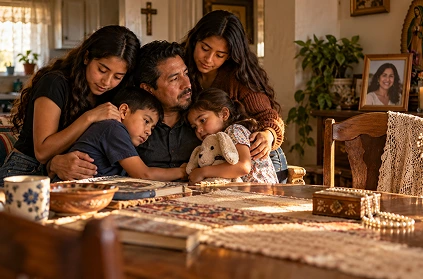
What happens when a daughter grieves a mother she was too young to remember?
Can family stories become memories when personal memories do not exist?
What can coping with the loss of a mother look like when there are no memories to hold on to?
What remains after sorrow changes shape but never entirely disappears?
Grief Begins Before Memory
Mama’s Pearls by Sylvia Villasenor approaches maternal loss from a deeply affecting place. Villasenor was four months old when her mother died. She mourns a person, but also every embrace, lesson, and ordinary moment she never received.
That absence follows her into adulthood. She imagines being welcomed after school, receiving advice, and sharing milestones. Her grief is not one dramatic event. It is a quiet presence returning whenever life reveals what motherhood means.
“My mother’s absence became something I carried with me every day.”
The line explains its intimacy. Grief becomes part of identity, yet never becomes the whole identity.
That recognition may comfort readers whose grief feels invisible because their relationship ended before shared memories could ever fully form.
Coping with Loss of Mother Through Borrowed Memories
Because Sylvia Villasenor cannot remember her mother directly, relatives rebuild her image. Her maternal grandmother and Aunt Nina Jose describe a hardworking, loving, determined woman whose influence survived.
Afterward, the children were sent to Mexico. Their grandmother offered stability, affection, and guidance. Nina Jose filled the maternal space with protection, warmth, food, clothing, laughter, and reassurance.
Healing may arrive through:
- Stories that preserve a loved one’s character.
- Relatives who provide safety without pretending to replace the person.
- Daily care that turns family history into emotional belonging.
The book never suggests that another person erases grief. Instead, loving support surrounds an absence and makes life livable.
Beyond the Loss of a Loved One
This is not solely a grief narrative. It deals with poverty, cultural change, hard work, little education, early marriage, and a widower raising seven children for an immigrant family.
The readers will see how money, tradition, faith, gender roles, and migration bring grief. Siblings take responsibility. Women carve independence from limited choices.
The father is not simplified into a hero, nor reduced to his failures. His anger bred fear, but his labor created opportunities. This complexity produces understanding, not excusing pain.
What the Pearls Really Mean
The pearls are values carried between generations. They are not polished phrases divorced from difficulty but lessons learned through endurance, observation, mistakes, forgiveness, and love.
Readers encounter lasting pearls:
- Resilience is built through faith, hard work, support, and persistence.
- Motherhood lives on in the values passed from one generation to the next.
- Forgiveness allows people to release resentment without ignoring the pain of the past.
- Family stories protect identity from silence and time.
Here, living with a mother’s deeply felt absence becomes more than managing sadness. It means discovering how love continues through habits, choices, siblings, children, grandchildren, and recorded memories.
Why This Story Was Written
Mama’s Pearls preserves family history for future generations. It honors parents whose sacrifices their children understood only later. It also gives first-generation families a vivid, recognizable account of ambition, displacement, responsibility, and belonging.
For readers coping with loss of a mother, the book offers companionship, not a formula. It acknowledges longing, jealousy, anger, spiritual questions, and imagined conversations, while showing that absence can coexist with purpose and tenderness.
The story belongs to one Mexican American family, but its questions are universal.
How do we understand imperfect parents?
Which memories deserve protection?
What wisdom should survive us?
Mama’s Pearls merits wide reading because it transforms grief into legacy without making grief look easy. It leaves readers recognizing that love can remain active, even when its original voice is gone.